
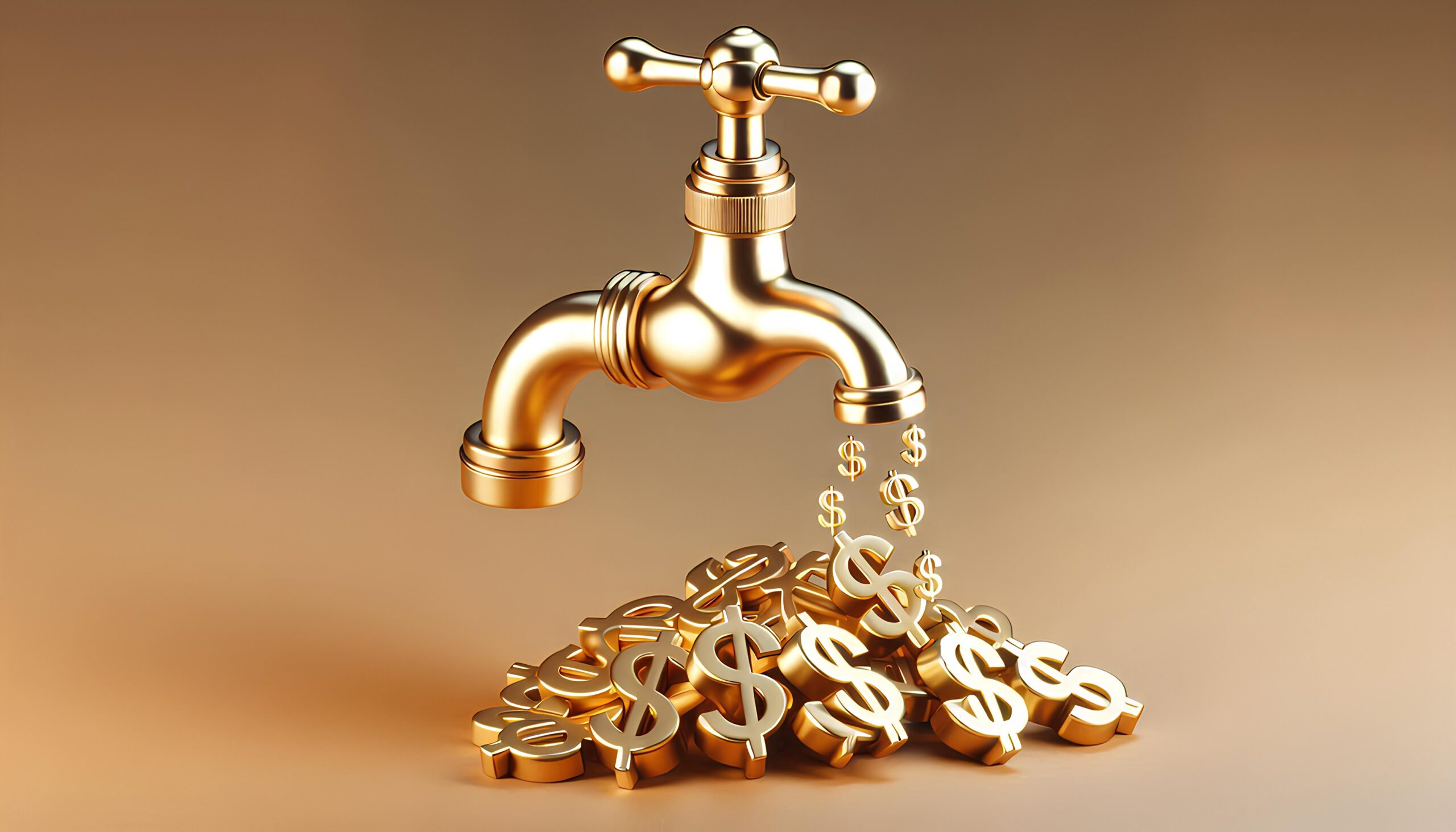
Insurance is part of the financial industry. Therefore, a reasonable assumption is that executives in the insurance industry would know that money costs money. Based on their actions, though, it seems many don’t know or have forgotten. The few that do truly understand this fact possess quite a competitive advantage.
The easiest example to explain the cost of money is to use a loan. I want to borrow $1 million. The bank is going to charge me 7% annual interest. The cost of money is 7% of the outstanding principal for the length of the loan. Let’s say I never make any principal payments. The loan is interest-only. Therefore, the cost of that money is $70,000 per year. It is not that different from renting a house. I am “renting” someone else’s money. If the lender could charge 8% without any additional risk, they should charge 8%. That is no different than an apartment owner who could charge $5,000 rather than $4,000. The lender has X amount of money to lend, and they must optimize their return relative to the risk of borrower default.
Some executives begin losing sight of the reality that money costs money when it comes to equity. Equity costs money, too; it is not free.
I attended a quarterly conference call with the CEO of an insurance company. (Some facts have been changed in this story to protect me, primarily.) The CEO explained that stockholders wanted a return on their investment. That shouldn’t be a surprise. A return on equity is the equivalent of the interest on a loan, but payment for the risk of buying a company’s stock. He went on to say that his company could not generate enough cash to make adequate dividend payments to shareholders. Shareholders do not receive interest payments, but they can be paid dividends, and dividends have a cost. This is why dividend yield is an important metric. It is usually far lower (60% or more) than the interest rate.
The CEO left out of his presentation that, unlike debt, where only one stream is available to the lender, equity has two streams. He left out the second stream: an increase in the stock price. Shareholders give a company money to invest, and they expect to be paid, in some combination, dividends and an increase in the stock price for the use of their money. How much they want depends on many factors, including risk. The riskier the investment, the more they demand.
For publicly traded insurance companies, my estimate is that investors want an average return of approximately 15% on their equity. (Stock carriers’ five-year average is approximately 15.5% per AM Best, versus the cost of equity, which is about 9% for stock carriers.) This means that if I give an insurance company $1 million, I want $150,000 per year in some combination of increased share price and dividends.
A company that cannot deliver is less valuable and has more difficulty raising money. Therefore, the company must promise more, which means a higher cost of equity. In this insurance company’s case, its cost of equity was approximately 45% higher than average. Frankly, it is nearly impossible to deliver a return that high to shareholders, which usually means the company will not be around for long.
Another example involves a broker who bought a lot of other brokers. In fact, I’ve seen many brokers do this. This broker made large down payments and then only calculated the cost of the debt for the remainder. In other words, in his mind, if he had money in the bank, it was free money. There was no cost. He valued his cash at 0%.
There is a cost, though. Consider two investments: one can generate 8%, and the other 12%. If you choose 8% with your “free” money, your opportunity cost is four percentage points, or 33%.
Valuing your cash at 0% has led to more than a few agencies being out of trust, being forced into a sale, having the existing shareholders’ values cut significantly when new shareholders are asked to save the company with their equity purchases, and so on. Nothing is free.
Another angle is that it costs money to make money. Most companies, especially small ones, have no idea how much it costs them to build their company. This is why it’s called “sweat equity.” Therefore, companies, even big companies, use hurdle rates and internal rates of return to judge the value, i.e., cost of their own money. This helps them better judge whether to make an investment or an acquisition because it acknowledges that their cash has a price.
Many serial buyers have been extremely lucky that the value of insurance distribution has skyrocketed. Most agency buyers are generating no operational or scaling efficiencies. This means that without financial engineering, applying accounting tricks and a lot of leverage, aided and abetted by the exponential expansion of the money supply, many serial acquisitions would have failed by now.
People, even finance executives, have a really difficult time understanding how something has a cost if it’s not listed on the income statement or, at least, the cash flow statement. The cost of stock options is that they dilute the value of the shares already owned by other stockholders. Now, if the stock price increases fast enough, and the dilution is minute, the other shareholders probably do not care. But not caring is not the same as being free.
Some people believe they understand that money costs money. These people usually think of it as the time value of money. Money today is worth more than money tomorrow, but how much more? In finance, this is called the discounted future cash flow, in which each future year’s cash flow is discounted at a compound rate. That percentage is the cost of money. If the cost of money is 15%, then it is discounted by 15% per year.
The concept that money costs money also applies directly to insurance premiums. Is it better to insure my art or save the money and invest it at 15%? Which is the better investment?
While money is flowing freely to private equity and equity markets in general, it can seem free even when it is not. Smart planners calculate the cost and spend or invest it accordingly.
If that carrier CEO had understood the two streams of equity, he might not have had to sell the company.
