



For the first time in a generation, college-educated fathers are spending substantially more time on their homes and kids than they did just a few years ago, often cutting working hours to do it.
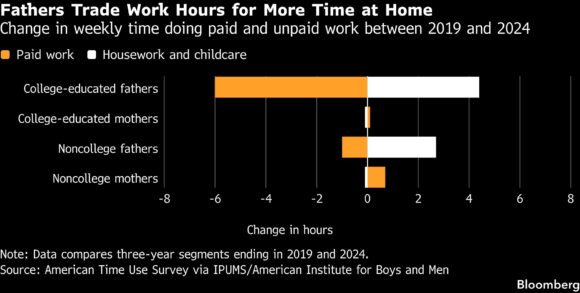
Their changing behavior has revitalized a narrowing of gaps with women — in both unpaid and paid work — that had largely stagnated for more than two decades. Between the three-year period ending in 2019 and the three-year period ending in 2024, college-educated dads boosted time spent on housework and childcare by more than four hours per week, while reducing paid work by six hours, according to new research published Wednesday.
“In this group of college-educated men with children, we’re seeing closer to a one for one substitution of less paid work with more housework, which is novel,” said Ariel Binder, a fellow at the American Institute for Boys and Men, who authored the study. “Women really changed their behavior over the decades leading up to the pandemic, but now this kind of shift in household priority seems to be driven by men.”
The study compares three-year segments of data from the annual American Time Use Survey released by the Bureau of Labor Statistics. The shift in fathers’ behavior is particularly pronounced in couples with at least one child under the age of 6.
Across couples of all education levels with young children, women continue to do 14.8 more hours of unpaid weekly work than men do — from cooking and cleaning to childcare. That gap, measured across the three years ending in 2024, is 3.8 hours less than the gap observed in the three years ending in 2019. Among the college-educated, this gap narrowed by 4.5 hours per week, to 12.7 hours more unpaid work done by young mothers than fathers.
Economists have regarded women’s outsize share of unpaid work as a key impediment to their labor force participation and advancement.
Kenji Yamauchi, a commercial video editor in New York City, says taking on about half of the family’s housework and childcare duties allowed his wife to complete her PhD studies and quickly secure a full-time job.
“When my daughter was born we realized that pretty much the only thing I cannot do is breastfeed,” said Yamauchi, 36. “Childcare is way more than the kid; it’s making sure the family runs, there’s food on the table, making sure everybody has clean clothes.”
Much of Yamauchi’s job can be done remotely, and his boss permits him to complete some tasks late at night or on weekends, allowing him to keep up with work.
For many fathers, however, doing more unpaid household work has been directly correlated with less time spent on the job, according to Binder. For married and cohabitating couples, the gap between men’s paid work hours and women’s narrowed by 29% between the 2019 and 2024 periods. Three-quarters of the difference came from men cutting their hours, rather than women spending more time at work.
The rise of remote work prompted by the Covid-19 pandemic may have been a catalyst, giving fathers more time and flexibility at home, Binder said. But he added that other factors at play too, including recent growth in healthcare and hospitality jobs that typically employ women. Together, remote work and increasing demand for service-sector jobs account for 44% of the shift, his data show.
“The data are consistent with the pandemic having some sort of lasting effect on household priorities and maybe gender norms,” Binder said. “In that theory, there was this initial kind of switch, a trigger that was flipped by the pandemic that isn’t easily going to be undone.”
Tom Knight, a 41 year-old from Brooklyn, estimates he now handles 80% to 90% of childcare and household chores after becoming a stay-at-home dad three years ago. He had dreamed of an early retirement after 15 years as a product manager for technology companies. He and his wife had saved and budgeted, but after his then-employer was acquired and he was laid off, they decided to let go of their nanny.
“Probably the deciding factor was that she enjoyed her job more than I enjoyed my job,” said Knight, who has an economics degree from Princeton University. He’s unsure of whether he’ll return to the workforce when his kids, ages 5 and 7, are older. His wife continues to work in digital marketing.
The new data dovetail with steady gains by women in the labor market. The share of prime-age women in the workforce is near a record high, and far more young women are earning college degrees than men. But other studies have suggested that women’s gains in the very top ranks of business and politics have stalled in recent years.
In early 2024, S&P Global Market Intelligence warned that a small decline in the number of women in C-suite roles may mark an “alarming turning point” for women in top corporate jobs. In the years since, legal activists and the federal government have pressured companies to drop diversity initiatives and scholarships, including many meant to help women advance.
Some economists warn that men’s increased involvement at home may not last, especially as employers rescind flexible-work arrangements.
“It’s really hard to sustain a new behavior when the environment around you is trying to push you back to the prior norms,” said Misty Heggeness, a professor at the University of Kansas and former principal economist at the Census Bureau.
While college-educated men may be more attuned to unpaid labor at home than earlier generations, Heggeness says she also credits women with driving some of the recent changes.
“Family life looks very different because women have higher ability to walk away if it’s not the type of lifestyle they want,” she said. “I think men are reacting to that.”
Richard Reeves, AIBM’s president, says the latest data is among the most striking indications yet that young men are driving a long-awaited “revolution in fatherhood” that will result in them becoming more equal partners at home.
“We’re actually seeing the term ‘family man’ not mean you’re at work with pictures of your kids on your desk, but that you are actively involved in the raising of your children,” he said.
Copyright 2026 Bloomberg.
